5. Use Headings and Subheadings to Structure Your Page
by Admin
Posted on 25-10-2023 10:12 PM

Title tags
title tags are one of the most important on-page seo elements, as they tell search engines what your page is about and appear as the clickable title in serps. Each title tag should be unique, descriptive and optimized with a keyword, and no longer than 60 characters. Including a keyword in your title tag helps improve your click-through rate from serps, as users are more likely to click on a result that is relevant to their search.
 Headings allow you to organize your
content
in a way that makes it easier for readers and search engine crawlers. The best headings focus on relevant words or phrases, so they’re not over-run with keywords.
Headings allow you to organize your
content
in a way that makes it easier for readers and search engine crawlers. The best headings focus on relevant words or phrases, so they’re not over-run with keywords.
Header tags (h1, h2, etc. ) help google understand the content on your pages. They also help readers understand your content and improve readability. As for the h1 tag, it’s best practice to use one h1 per page and match it with the page title. To find pages with missing or empty h1 tags, crawl your site with ahrefs’ site audit and go to the content report. You can do this for free with an ahrefs webmaster tools (awt) account. As for h2 to h6 tags, simply use them for the subheadings of your content. Set a title tag on every indexable page.
H1-h6 header tags are html elements that create a visual hierarchy of a web page, which helps users and search engines quickly scan and interpret the content of a web page. Maintaining hierarchy through header tags is a crucial aspect of on-page seo. You’ll want to start with a single h1 tag, followed by h2 and h3 subheadings. The page structure should look something like this: if additional header tags are needed, continue to use the rest of the h4-h6 tags in the same hierarchical order. Tips for header tag optimization: include the h1 tag above all other subheadings. Apply no more than one h1 tag per page.
Conduct thorough keyword research to identify relevant and high-volume keywords for your content. Optimize your page's title tag, meta description, headings, and content with targeted keywords. Ensure a natural keyword density throughout the content without keyword stuffing. Quality #content creation: create high-quality, original, and informative content that satisfies the user's search intent. Make sure your content is well-structured, easy to read, and includes relevant headings and subheadings. Incorporate multimedia elements such as images, videos, and infographics to enhance user engagement. Url optimization: use seo -friendly urls that include relevant keywords and are concise and descriptive. Ensure the url structure is logical and follows a hierarchical format.
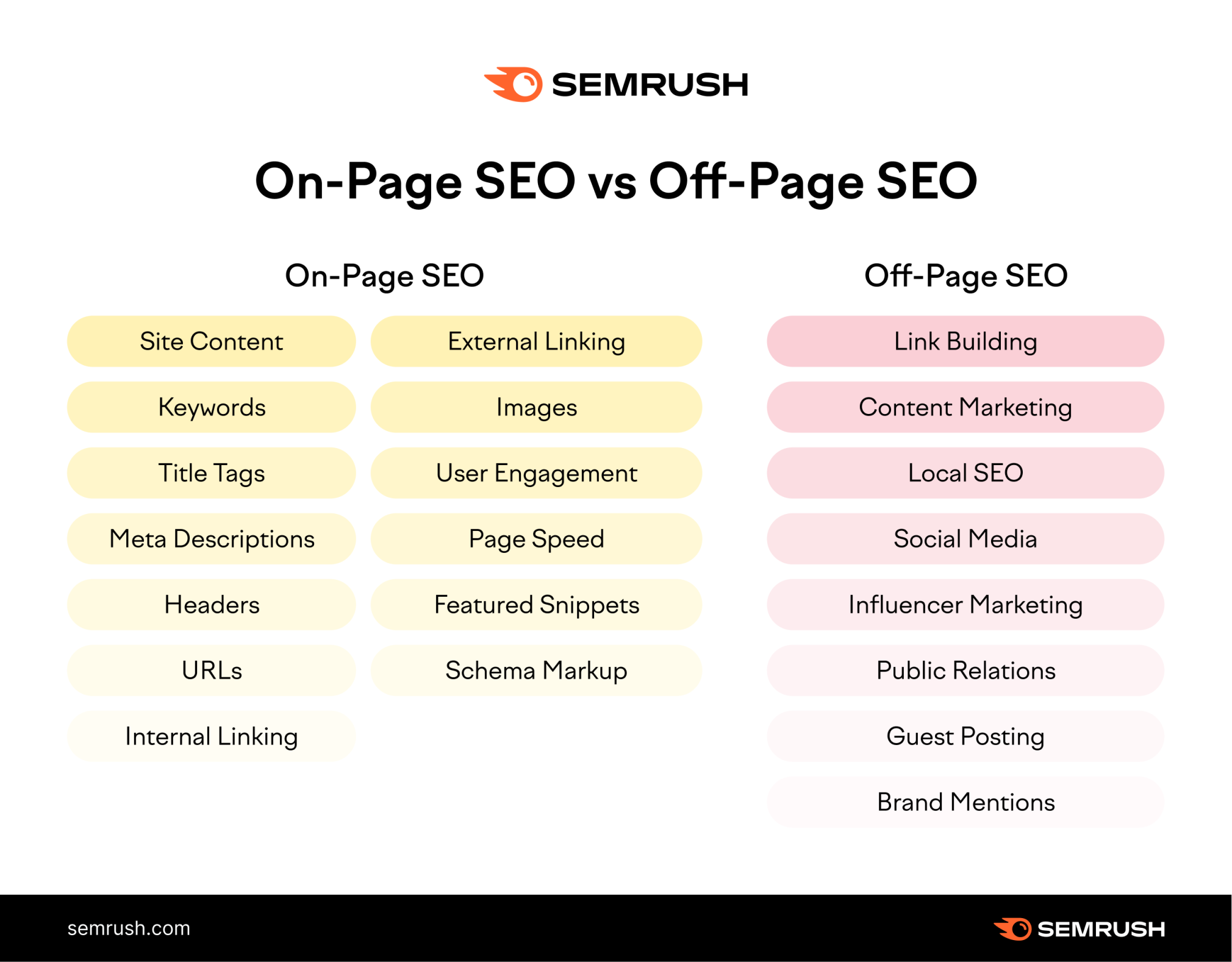
Onpage seo refers to the factors you can influence to optimize your website for search engines . This includes, for example, the structure of your urls, the use of headings, the optimization of images and the use of meta tags.
7. Add Internal Links
Use h1, h2 tags to highlight important keywords or phrases on the page where you think they fit best.
Try using keyword-rich anchor text links to other pages on your website whenever possible. If you include links within the content, make sure they are do-follow links where it makes sense. Add internal links with relevant keywords linking to essential pages of the site; thus, using keyword-rich anchor text will help google understand how your page is relevant to the rest of the website. Keep your site updated and relevant to the latest industry news as google looks at how well you update your content to determine if you're a high-quality or low-quality website.
Linking internally to other pages on your website is useful to visitors and it is also useful to search engines. Here’s an internal link to another blog post on our site that talks more about internal linking. Very meta. When adding internal links, make sure to have relevant anchor text. Anchor text is the clickable text in a hyperlink (usually indicated by blue font color and underline). To optimize your anchor text, make sure the selected word or phrase is relevant to the page you’re linking to. On-page seo ensures that your site can be read by both potential customers and search engine robots.
Internal links are great for boosting articles you want to rank without acquiring external links. But there is a right and a wrong way to make use of internal links. Here are some tips: don’t add too many internal links. The authority that flows from one page linking to 10 articles is less than when linking to 5 articles. Preferably, only link to articles that you want to rank. You might have web pages that just need a small boost to reach that top 1 position. Try to link to such articles over random articles that in 2 years never even saw page 20 of google.
On-page seo is the process of optimising content for both search engines and users. Also known as on-site seo, on-page seo involves optimising for the signals that happen on your website. From optimising title tags and content to adding internal links and implementing structured data, we will talk you through every step of the process in this guide to on-page seo.